
Following the Heraldic Trail: How a Pub Sign Uncovered the History of Ammerdown
From a village pub sign to parish registers, wills and published pedigrees, an investigation into how heraldry can illuminate family history.
One of the pleasures of genealogical research is that the next clue often appears where you least expect it. It might be hidden in a parish register, a probate inventory, a newspaper advertisement or, in this case, hanging above the door of a village pub.
For me, the story began during an Institute of Heraldic and Genealogical Studies (IHGS) lecture on heraldry. The subject was not Somerset at all, but a Hampshire pedigree centred on John Jolliffe, Member of Parliament for Petersfield. Until then, I had always assumed the Jolliffes of nearby Ammerdown were simply an established Somerset family. Yet here they were, firmly rooted in Hampshire.
The obvious question followed.
How had a Hampshire family come to own the Ammerdown estate?
A few months later, while enjoying a Christmas walk through the Ammerdown Estate near Kilmersdon, I found myself thinking about that question again. Today, the estate is perhaps best known as one of Somerset's most recognisable filming locations. Its elegant eighteenth-century house and landscaped parkland have provided the backdrop for productions including Poldark, Persuasion, Rivals and ITV's Gone. Long before it appeared on television screens, however, Ammerdown was at the centre of a fascinating story of inheritance stretching back more than two centuries.
A local historian offered me a tantalising clue.
"A Miss Kilmersdon."
That was all.
Intrigued, I wandered into the nearby Jolliffe Arms, the village pub that still bears the family's name and proudly displays their coat of arms above the entrance. Looking up at the painted shield, I realised I was staring at the first piece of evidence.
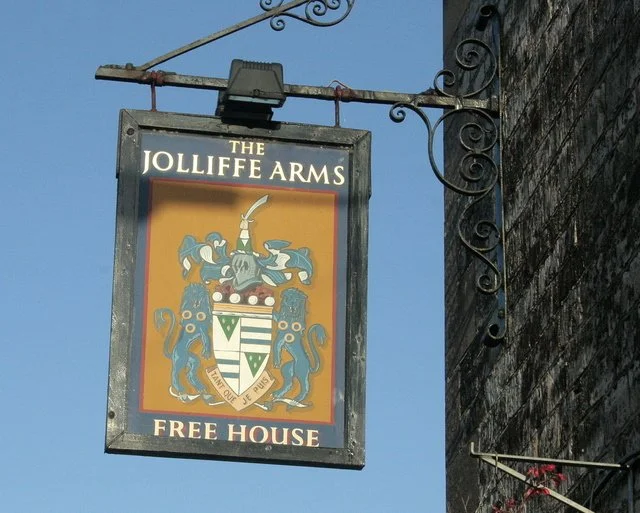
The Jolliffe Arms in Kilmersdon, Somerset
Reading a Coat of Arms Like a Detective
To many people, a coat of arms is simply an attractive piece of decoration. To a genealogist, it is another historical record waiting to be interpreted.
Every colour, every symbol and every quartering tells part of a story. Like a parish register or a probate inventory, heraldry provides evidence—but only when read alongside other contemporary sources.
The shield above the Jolliffe Arms immediately raised questions. It was divided into four quarters. Two displayed the arms of the Jolliffe family, while the other two belonged to the Hyltons. Heraldry rarely combines two unrelated families without good reason. Somewhere in the pedigree there had been an important marriage that united the two.
To identify precisely which branch of the family these arms represented, I turned to two of the standard works of heraldic reference: Papworth's Ordinary and Burke's General Armory. Rather than indexing arms by surname, these remarkable works allow researchers to identify a family from the design of its coat of arms.
Several Jolliffe entries matched elements of the shield, but one stood out immediately: Jolliffe, Baron Hylton. It matched every significant feature of the pub sign, including the supporters, crest and motto.
The coat of arms had done exactly what good historical evidence should do.
It hadn't answered the question.
It had simply pointed me in the right direction.
Understanding Heraldry: What is a Blazon?
One of the first steps in any heraldic investigation is to blazon the coat of arms. A blazon is the formal language of heraldry. Rather than relying on an illustration, a heraldic artist can accurately recreate a coat of arms simply by reading its description.
The language follows a precise order, describing first the field (the background of the shield), then the charges (the symbols placed upon it), followed by their colours—or tinctures—and finally any additional features such as quarterings or marks of cadency.
The Jolliffe arms are blazoned:
Argent, on a pile vert three dexter hands couped at the wrist of the first.
Translated into everyday English, this means:
Argent – a silver (or white) shield.
Pile vert – a green wedge rising from the base of the shield.
Three dexter hands couped at the wrist – three right hands, cleanly cut at the wrist.
Of the first – the hands are the same colour as the first tincture mentioned: silver.
Once a coat of arms has been blazoned, it can be compared with reference works such as Papworth's Ordinary and Burke's General Armory to identify the family entitled to bear it.
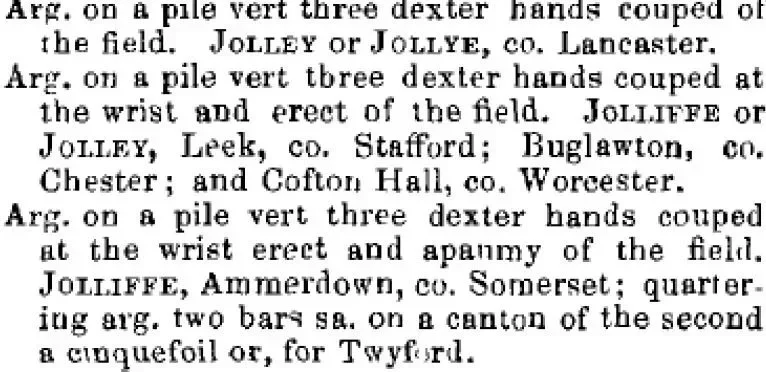
Papworth’s Ordinary
Following the Documentary Trail
Heraldry can suggest relationships, but it cannot prove them.
The next stage of the investigation moved from armorials to genealogy. Published pedigrees in Burke's Landed Gentry, Burke's Commoners and other genealogical works provided an invaluable framework for the research, but they were never accepted at face value. Like all compiled genealogies, they were treated as guides rather than evidence. Every generation was checked against contemporary sources, parish registers, probate records, census returns, newspapers and estate papers, before any conclusions were drawn.
Only then did the family story begin to emerge.
The Jolliffes could be traced back through Cofton Hall in Worcestershire before arriving at John Jolliffe, MP for Petersfield; the very man whose pedigree had first sparked my curiosity during the IHGS lecture.
John had two sons, and their marriages shaped the family's future.
The elder son, William Jolliffe, married Eleanor Hylton, heiress to the Hylton family. Through that marriage the family acquired the right to quarter the Hylton arms, and their descendants would later be created Barons Hylton, explaining why the Hylton quartering appears so prominently on the pub sign.
The younger son's marriage, however, proved to be the answer to the mystery.
Finding "Miss Kilmersdon"
In 1778, Thomas Samuel Jolliffe married Ann Twyford, the only daughter and heiress of the Reverend Robert Twyford of Kilmersdon.
She was "Miss Kilmersdon."
Through that marriage, Thomas Samuel acquired extensive Somerset property, forming the nucleus of what became the Ammerdown estate. The Jolliffes had not arrived in Somerset through ancient roots in the county, but through a marriage to a local heiress.
Further research revealed the story behind Ann's inheritance. Sir Hylton Jolliffe's nineteenth-century family history recounts how the Kilmersdon manor descended through the Twyford family before passing to the Reverend Robert Twyford and, ultimately, to his only daughter, Ann. Thomas Samuel is said to have met Miss Twyford while visiting friends in the neighbourhood, and their marriage brought the estate into the Jolliffe family.
The mystery posed by that brief remark had been solved.
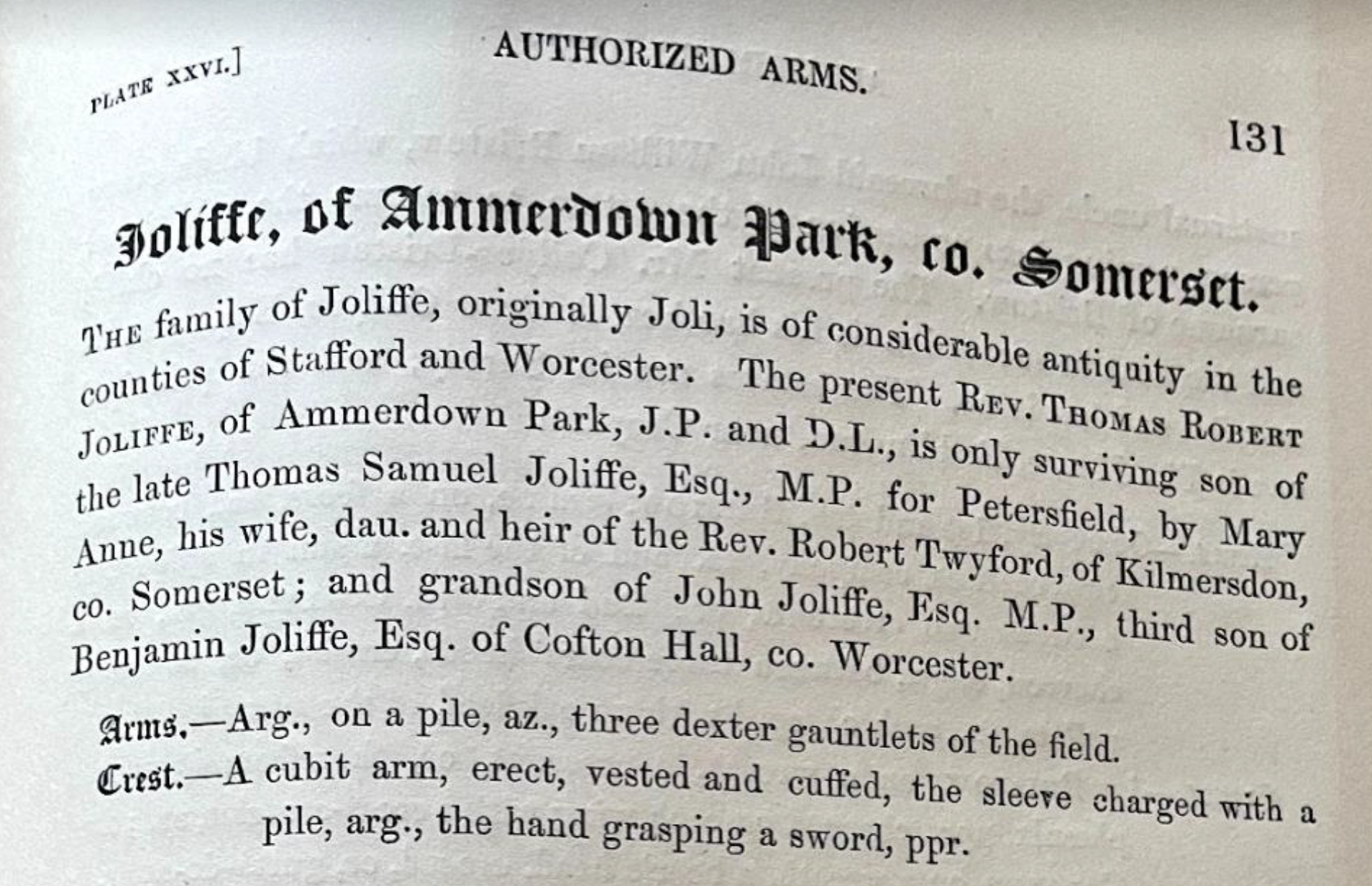
Burke’s Authorized Arms (Harrison 1860)
An Unexpected Twist
It would be easy to assume that the Ammerdown estate remained with the descendants of Thomas Samuel and Ann Twyford.
It did not.
Their youngest son, Charles, was killed at the Battle of Waterloo in 1815. His brothers, John Twyford Jolliffe and the Reverend Thomas Robert Jolliffe, never married and left no children. When the Reverend Thomas Robert died in 1872, the Ammerdown branch of the family came to an end.
Instead, the estate passed to their cousins, the descendants of William Jolliffe and Eleanor Hylton.
Suddenly the heraldry made perfect sense.
Ammerdown had come into the family through Ann Twyford, but it ultimately passed to the Hylton branch. The quartered coat of arms displayed outside the Jolliffe Arms reflects that later inheritance, bringing together the histories of two marriages that shaped the family's fortunes in very different ways.
Looking Beyond the Shield
Researching the Jolliffe family reminded me that heraldry deserves far more attention than it often receives from family historians.
It is easy to think of coats of arms simply as colourful decoration or symbols of status. In reality, they are another class of historical evidence. They record inheritance, family connections and social identity, but only when interpreted alongside documentary sources.
In this investigation, a painted pub sign led to an eighteenth-century marriage, a Somerset heiress, the acquisition of the Ammerdown estate and the later history of the Barons Hylton. None of those discoveries would have emerged from the heraldry alone, nor from the documentary sources in isolation. It was only by combining the two that the story became clear.
Today, visitors to the Jolliffe Arms walk beneath the same coat of arms without giving it a second thought. I suspect I would once have done the same.
Now, whenever I see it, I no longer see just a handsome heraldic achievement.
I see the story of "Miss Kilmersdon."
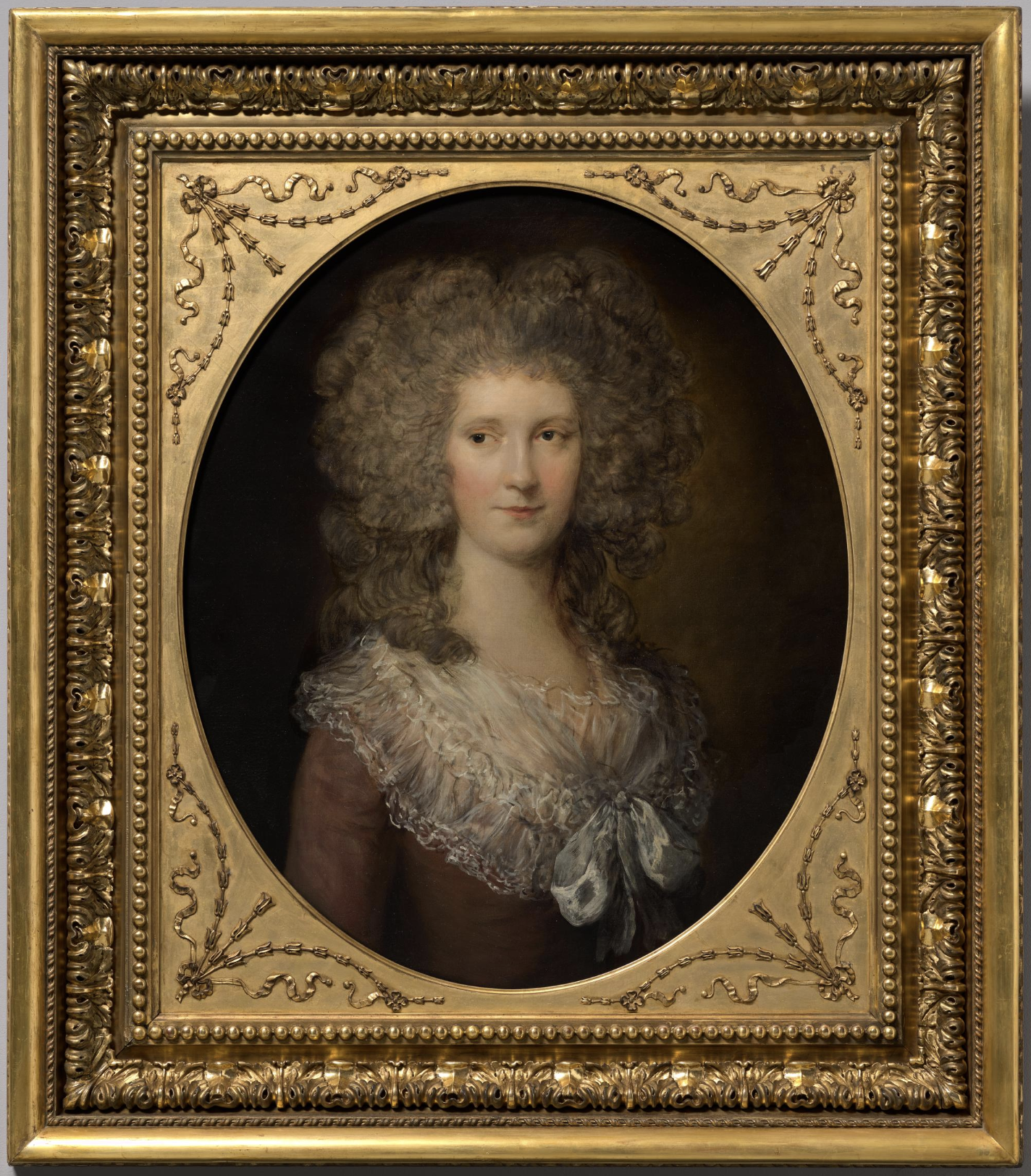
Portrait of Mary Anne Jolliffe after 1788 by Gainsborough Dupont (British, 1754–1797) c/o The Cleveland Museum of Art