
Beyond the Parish Register: Reconstructing a Wiltshire Congregational Family
"The people of this generation little realise what they owe to their Puritan ancestors..."
With those words, Mary "Polly" Bristol began a memoir in January 1932, only a few months before her death at the age of eighty-five. What followed was not simply a family history, but a vivid account of a rural Congregational community stretching back more than two centuries. It was a story of ministers driven from the established church, determined villagers building their own chapel, and generations of families whose lives revolved around it.
For a genealogist, it was irresistible.
Family memoirs are wonderful sources, but they also demand caution. Memories soften over time, stories become polished in the retelling, and chronology is rarely precise. The question was not whether Polly's account was true or false, but how much of it could still be found in the surviving records.
As it turned out, an extraordinary amount.
"The Gospel was preached..."
Polly began her story long before the Bristol family appeared.
She traced the origins of Tisbury's Congregational church to the Great Ejection of 1662, when ministers unwilling to conform to the Act of Uniformity left the Church of England.
"...these men who were scattered abroad went everywhere preaching the Gospel..."
She described worship in a barn at Chicksgrove before the congregation resolved to build a chapel of its own in Tisbury. According to Polly, that decision was fiercely opposed.
"...as they dug out the foundations during the day [others] threw it all back again in the night..."
Then comes one of the most memorable passages in the memoir.
"...some of the women of the Alford family took their spinning wheels and sat in the trenches to protect the work..."
It is difficult not to picture the scene.
Even more striking is that the story accords closely with the documented history of the first Independent chapel built in Tisbury in 1725–26. Local opposition was real, and family tradition had preserved one vivid image that official records never could.
The Alford family would later become central to my own research when Samuel Bristol married Jenny Alford in 1798.
The clue hidden in the parish registers
The documentary trail began exactly where most genealogical research begins: the parish registers.
Samuel Bristol's marriage to Jenny Alford was easily found in the register of St John the Baptist, Tisbury. The family's burials also appeared there over successive generations. The baptisms did not. That absence is one of the classic signatures of a Nonconformist family.
Following the Act of Toleration in 1689, Protestant dissenters could generally baptise their children in their own meeting houses. Marriage, however, remained subject to different legislation. Under Lord Hardwicke's Marriage Act of 1753, with the important exceptions of Quakers and Jews, legally recognised marriages had to take place according to the rites of the Church of England until civil registration began in 1837. Burials likewise often continued in parish churchyards because few chapels possessed burial grounds of their own.
The result is familiar to anyone researching Nonconformist families. Marriages survive. Burials survive. The baptisms appear to vanish.
Except they have not vanished at all. They are simply waiting in another archive.
The chapel records
The registers of Zion Hill Chapel supplied exactly what the parish registers lacked.
Samuel and Jenny's children appeared one after another in the baptism register. Membership books, attendance registers and burial records then carried the family through the nineteenth century, recording admissions to membership, absences through illness and eventually their burials in the chapel's own cemetery after it opened in 1843.
The Bristols had never disappeared. The records had simply followed their faith.
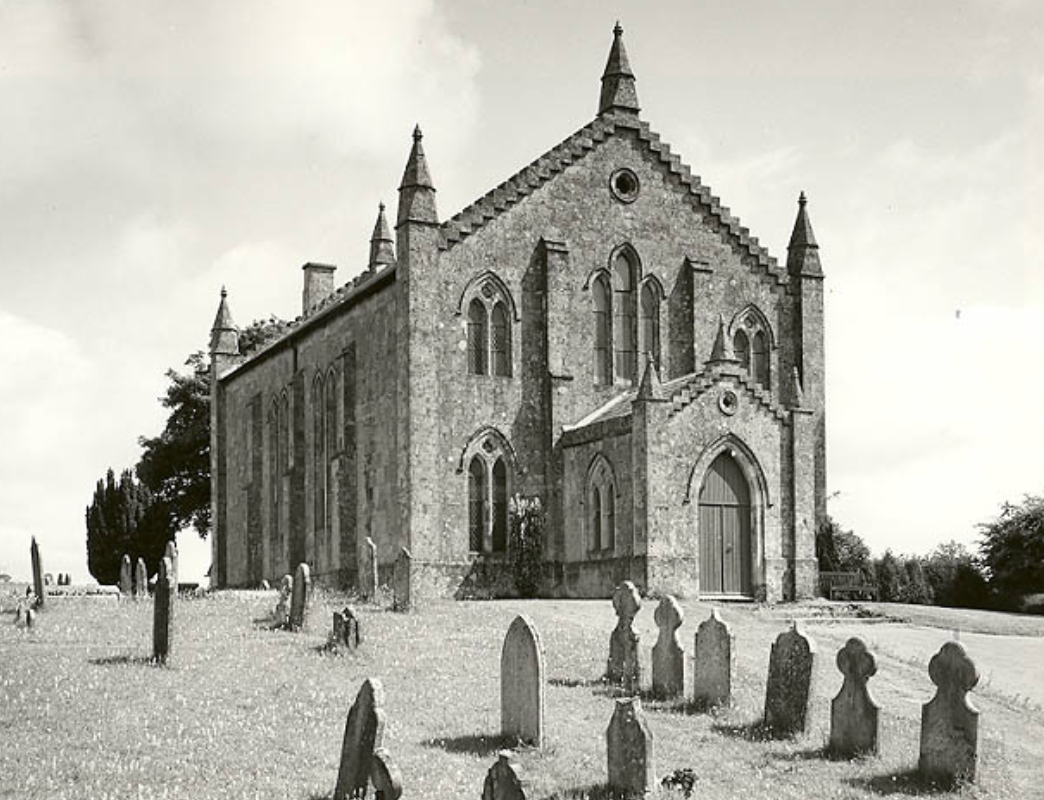
Zion Hill Chapel, Tisbury c/o WSHC Community History
A family at the heart of the congregation
Polly's memoir now became even more valuable because the documentary evidence increasingly matched her recollections. She remembered her grandparents travelling three and a half miles to chapel every Sunday.
"...Grandmother on a pillion behind her husband and sometimes a child in front..."
She remembered Samuel Bristol buying the congregation's first organ.
Then came one of my favourite passages. Unable to find anyone locally who could play it, Samuel visited his youngest son James at school.
"Jim, you have to learn music and you must be quick about it, for you will have to play the organ at chapel."
James did exactly that. He became organist and choirmaster for more than forty years.
It is a delightful family story, but it also reveals something fundamental about Congregational life. Independent chapels depended upon the talents of their own members. Music, Sunday Schools, finance, maintenance and governance all rested upon willing volunteers drawn from within the congregation.
The chapel was not simply where the Bristols worshipped. It shaped their identity.
Building Zion Hill
By the 1840s the old meeting house had become too small. Polly remembered her grandfather leading the campaign for a new chapel. He pledged £100 himself, another £100 from each of his three sons, and promised a further £100 if the rest of the congregation matched their generosity.
They did. Stone was quarried from the hillside itself, the building rose directly from the solid rock, and Zion Hill Chapel opened in 1842.
Polly never doubted what that achievement meant.
"It is indeed a monument of skill and perseverance... set on a hill that cannot be hid."
The surviving subscription lists, trustees' papers and chapel records tell us who built Zion Hill.
Polly tells us what it meant to those who built it.
"The quarrel"
Near the end of the memoir Polly briefly mentioned what she simply called "the quarrel."
The minister refused to resign. The trustees locked the chapel against him. Some members left, taking the Sunday School registers with them. A new chapel was eventually established. Without the archives it reads almost like family folklore.
The archives reveal something much larger.
Church minutes record the dismissal of Thomas Giles. A formal letter survives bearing the signatures of Samuel Bristol and his three sons among the trustees. The disagreement developed into a libel action in which Giles accused James Bristol and the trustees of conspiring to destroy his reputation. Court papers describe them as "a clique of men, all related to each other."
Neither account is complete.
Together they reveal both the human memory and the documentary reality of one of the defining episodes in the congregation's history.
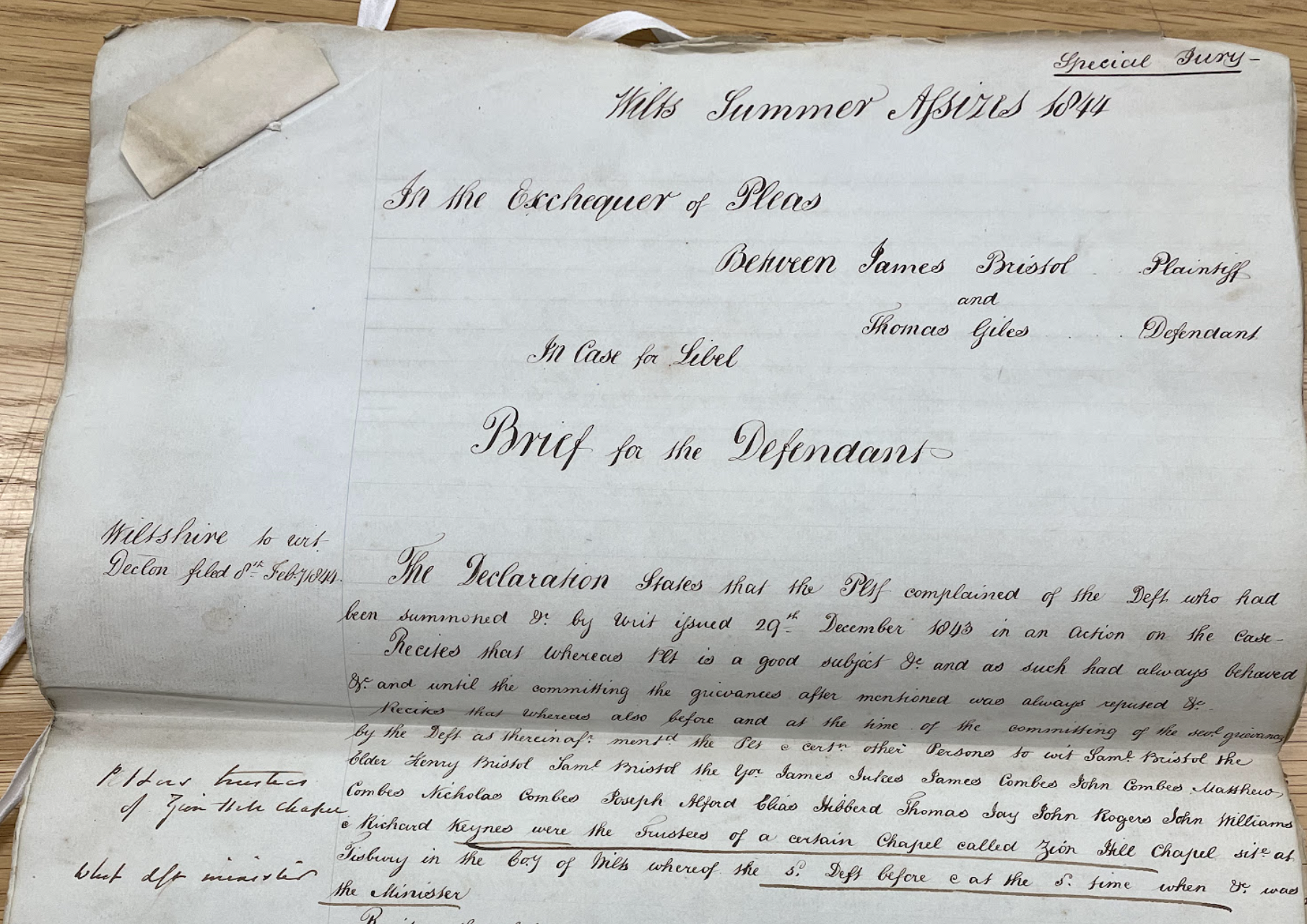
Bristol v Giles Libel Case c/o WSHC 212B/6567
Beyond the parish register
Researching the Bristol family reminded me that genealogy is rarely about finding one missing record. It is about understanding why that record is missing.
Parish registers provided the framework. Chapel registers filled the gaps. Membership books revealed participation. Trustees' minutes documented responsibility. Court papers exposed conflict. Polly's memoir supplied the personalities, humour and humanity that none of those records could ever capture alone.
No single source reconstructed the Bristol family. Together, they did.
When Mary Bristol sat down to write her recollections in 1932, she could never have imagined that they would one day be compared with eighteenth-century chapel registers, nineteenth-century church books and Victorian legal proceedings. Yet almost a century later they continue to illuminate one another.
For me, that is the enduring lesson of this research. Parish registers remain the backbone of family history, but they are rarely the whole skeleton.
Sometimes the most rewarding discoveries begin not with what the parish register records...but with what it leaves out.
Author's Note:This article is based on research originally undertaken as part of my Diploma in Genealogy, subsequently expanded through research at the Wiltshire and Swindon History Centre, The National Archives and other repositories. Polly Bristol's memoir, preserved by her descendants, provided an invaluable starting point for reconstructing the history of the Bristol family and the Congregational community at Tisbury.