
Beyond the Parish Register: How Manorial Records Solved a Family Legend
How deeds, probate and manorial records can bridge the gaps left by parish registers.
Every family has its legends. Mine claimed that we descended from the Elizabethan naval commander Sir John Hawkins (1532–1595). It was an intriguing possibility, but one that required evidence rather than family tradition.
Investigating the claim gave me an opportunity to apply techniques developed during the IHGS Diploma in Genealogy. Chief among them was a lesson that every professional genealogist soon learns: parish registers are only the beginning of seventeenth-century research. Successful investigations depend on combining many different record types; probate, title deeds, taxation records, maps and, perhaps the most underused of all, manorial records.
Thousands of manor court rolls, court books, surveys and rentals survive today in county archives and at The National Archives, yet many family historians never think to consult them. The Hawkins family proved an excellent example of how these records can bridge generations where parish registers fall silent, reveal hidden relationships and occasionally overturn a family's history altogether.
Looking Beyond the Parish Register
Most family historians are familiar with parish registers, census returns and probate records. Manorial records remain far less understood, yet they often preserve exactly the evidence that parish registers omit.
Court books recorded admissions and surrenders of copyhold land, surveys listed tenants and the acreage they occupied, while presentments documented breaches of manorial custom. Individually they can appear dry and administrative. Combined with parish registers and probate records, however, they become powerful genealogical evidence, as the Hawkins family illustrates.
Starting with a Barn in Chute
Rather than beginning with parish registers, I started with a title deed dated 1767; a routine conveyance of a barn and fourteen acres at Gammons Corner in Chute. Hidden within its wording was the crucial clue. The deed described Thomas Hawkins of Grafton as a son of John Hawkins of Tidcombe, yeoman, deceased, who had inherited the property under his father's will before selling it.
This was far more than a conveyance of land. It identified Thomas's father, confirmed that John had died before 1767, and pointed directly to a surviving probate record. Instead of chasing another elusive baptism, I went straight to the Wiltshire probate records.
John Hawkins' will, proved in 1734, transformed the research. It named his wife Elizabeth, identified his children, described land at Tidcombe, Wexcombe and Chute, and carefully set out how each property was to be inherited. Scattered baptisms suddenly became a documented family connected through inheritance.
One detail proved particularly significant. Part of the Chute estate was held by lease from the Duke of Somerset, Lord of the Manor of Tidcombe. If so, the family should also appear in the surviving records of that manor.
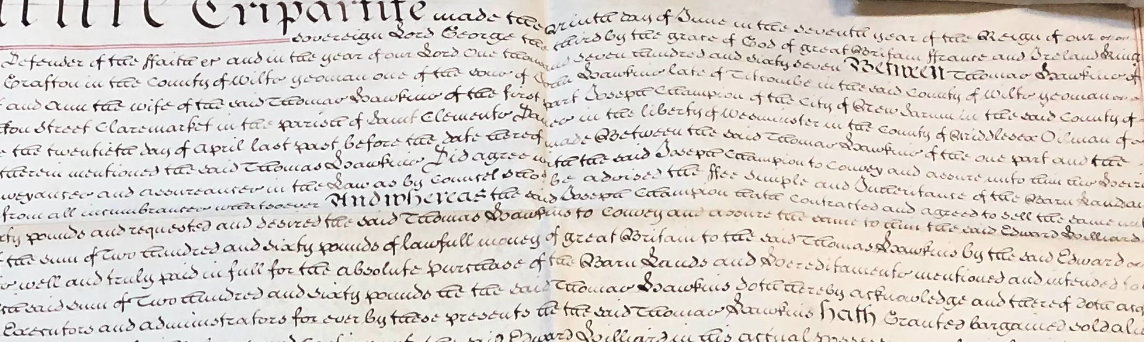
Conveyance by Thomas Hawkins of Grafton (1767) WSHC 9/17/10
The Manor Court Takes Over
The surviving survey and court book for Tidcombe confirmed exactly that. Following John's death, his widow Elizabeth was admitted to her widowhood holding, a copyhold estate of around sixty-nine acres, and the survey listed each of her sons individually with their own holdings. Suddenly the family could be followed through the land itself, not simply through baptisms and burials.
Even more revealing were the court proceedings recorded during John's lifetime. Time after time he appeared before the manor court for breaking its regulations: grazing more sheep on the common than he was entitled to, keeping livestock in the wrong pasture and sowing crops contrary to manorial custom. Each offence attracted a fine, carefully entered into the court book by the steward.
These entries do more than record fines, they reveal character. Three centuries later, John Hawkins emerges not simply as another name in a pedigree but as an active farmer navigating, and occasionally ignoring, the rules of everyday manor life. He suddenly feels remarkably human.
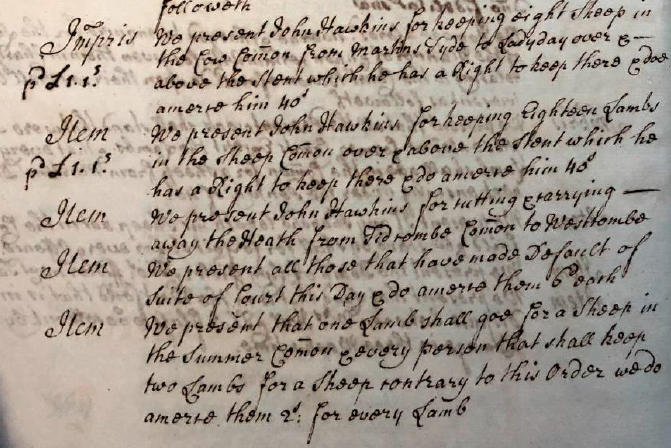
Manor of Tidcombe Court Book (1711--1780) WSHC 1005/1
Following the Land Backwards
John's will also referred to an estate at Wexcombe in the neighbouring parish of Great Bedwyn. The next breakthrough came from the will of Robert Hawkins of Wexcombe, proved in the Prerogative Court of Canterbury in 1736. Robert named his late brother John Hawkins of Tidcombe and John's children, firmly linking the two families. The question now became: who was their father?
The parish registers provided the answer. They identified John Hawkins, Thomas, William, Joseph, Richard and Benjamin as sons of Thomas Hawkins of Wexcombe. Robert's own baptism has not been found, but the brothers named in his will correspond so closely with those recorded in the registers that he can be placed confidently within the same family.
The registers also record the burial of Thomas Hawkins the elder of Wexcombe in 1714. A transcription of the Great Bedwyn monument inscriptions notes that he died aged eighty-four, placing his birth around 1630 and leading to his will, proved in 1715, which names many of the same sons.
Finally, the surviving surveys of the Manor of Wexcombe, dating from 1682, 1708 and around 1716, trace Thomas and his sons through their copyhold holdings. They record approximate ages and document the family's land passing from one generation to the next over more than thirty years.
By this stage, four independent classes of evidence, parish registers, monument inscriptions, probate records and manorial records, all pointed to the same family reconstruction.
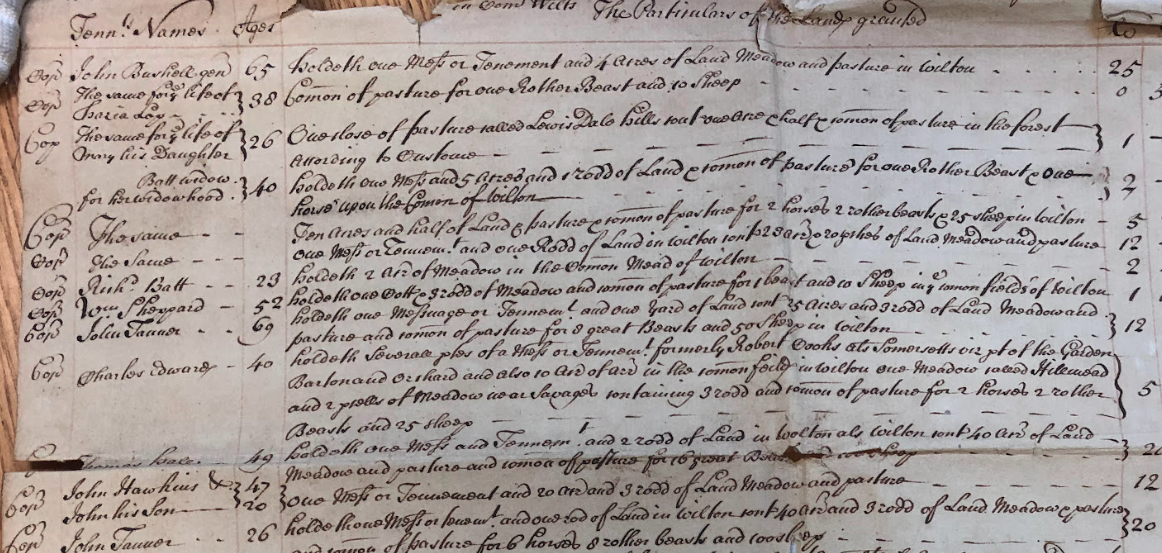
Survey of the Manor of Wexcombe cum Wilton and West Bedwyn (c1716) WSHC 9/27/54
A Name Begins to Change
Searching for Thomas Hawkins' baptism around 1630 produced an unexpected result. There was no convincing baptism for Thomas Hawkins, but there was one in 1631 for Thomas Lightfoot.
At first this appeared to belong to an entirely different family. Then further records emerged, a burial, a marriage and additional baptisms. Some described the family as Lightfoot, others as Hawkins, while several used both together: Lightfoot alias Hawkins. The deeper the investigation went, the clearer it became that Lightfoot had been the family's original surname.
The Lightfoot Alias
Thomas Hawkins of Wexcombe had in fact been baptised Thomas Lightfoot. His father married as John Lightfoot, baptised his early children under that surname, yet later records referred to him as John Hawkins of Wexcombe.
Probate records bridged the transition. A will proved in 1624 belonged to Thomas Lightfoot alias Hawkins, while an earlier will from 1593 was made by John Lightfoot alias Hawkyns of Wilton. Both referred to property at Wexcombe and corresponded closely with the later manorial evidence.
Why the family adopted a new surname remains uncertain. Aliases were not uncommon during this period. They might distinguish one branch of a family from another, preserve an inherited surname or arise through long-established local custom. Whatever the reason, the documentary evidence demonstrates a gradual transition from Lightfoot to Hawkins across several generations; a discovery that no search of parish registers alone could have revealed.

Halkines alias Litefoote. Great Bedwyn, Wilts. BT Baptism 1633. WSHC Bt/Gtbd/Bdl.1a
What Happened to the Family Tradition?
Ironically, the answer to the original question was now clear. John Lightfoot alias Hawkyns of Wilton was indeed a contemporary of Sir John Hawkins, but not his descendant. He was a Wiltshire husbandman rooted in the Kennet Valley, and the family remained at Wexcombe, Great Bedwyn and neighbouring villages for generations, with no documentary connection to the celebrated Hawkins family of Devon.
The family tradition did not withstand documentary scrutiny. Yet that hardly mattered.
More Than a Famous Ancestor
Perhaps the greatest misconception in genealogy is that success lies in discovering royalty or famous ancestors, when the most rewarding research often concerns ordinary people.
This investigation reconstructed five generations of Wiltshire yeomen who would have remained largely invisible had I relied solely on parish registers.
More importantly, they brought those people back into view. John Hawkins arguing with the manor court over grazing rights; widows formally admitted to copyhold estates; sons succeeding fathers on the same holdings generation after generation. These are the details that rarely appear in a pedigree but provide genuine insight into the lives our ancestors lived.