
Reconstructing the Life of Lieutenant John Poulton Williams RN
Tracing the life of a Royal Navy officer through Admiralty records, muster rolls and original historical sources.
Family historians are often fortunate if they can identify an ancestor who served in the Royal Navy. A baptism, perhaps a naval pension, or a brief entry in a published index may confirm that a man went to sea. Reconstructing an entire naval career, however, is another matter altogether.
The life of Lieutenant John Poulton Williams demonstrates just how much can be uncovered by bringing together Admiralty records, muster rolls, Navy Lists, parish registers, probate records and contemporary newspapers. Individually, each source offers only a glimpse. Together, they reveal the story of a young officer who spent almost his entire life in the service of the Royal Navy, fought at the Battle of Trafalgar, and was killed in action before his twenty-seventh birthday.
A Childhood in Britain's Greatest Naval Dockyard
John Poulton Williams was born on 8 April 1784 at Plymouth Dock, later renamed Devonport, one of the principal dockyards of the Royal Navy during the wars against Revolutionary and Napoleonic France. It was a community where almost every family depended, directly or indirectly, upon the Navy, and few children could have grown up more immersed in that world than John.
His father, John Hoyle Williams, was a Master Shipwright at the Royal Dockyard, one of the senior civilian officers responsible for constructing and repairing His Majesty's ships. It was a position carrying considerable responsibility and prestige. The family's naval connections extended back another generation. John's grandfather, Poulton Williams, had been a prosperous chandler and soap boiler serving the dockyard community, while his great-grandfather had worked as a Master Carpenter during the earliest years of the dockyard's development.
This was not a family of naval aristocracy, but one whose livelihood and identity were closely bound to the Royal Dockyard. Shipbuilding, naval administration and the sea formed the backdrop to everyday life, making it little surprise that John himself embarked on a naval career from an exceptionally young age. In time, his two younger brothers, Thomas and Poulton, would follow him into the Royal Navy, but it was John who first carried the family tradition to sea.
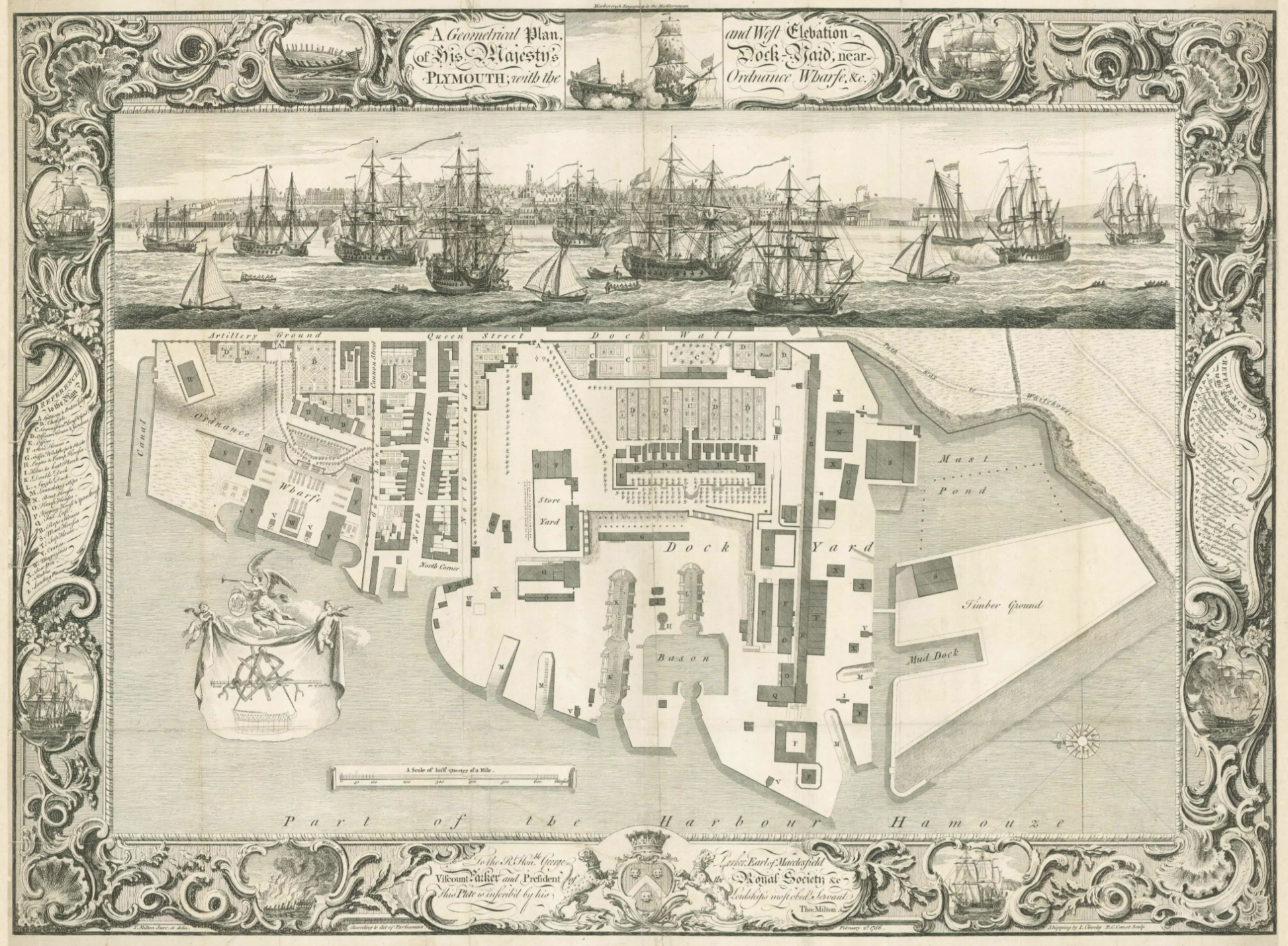
The first printed map of the Royal Dockyard at Plymouth By MILTON, Thomas , 1753
The Record that Unlocks a Naval Career
One of the most valuable, yet frequently overlooked, sources for researching Royal Navy officers is the Lieutenant's Passing Certificate.
Before a prospective officer could receive his commission as Lieutenant, he had to appear before a board of senior captains and demonstrate his knowledge of seamanship, navigation and naval practice. These certificates survive among the Admiralty records at The National Archives and are remarkably informative. They normally record a candidate's age, place of birth, the ships on which he had served, his rating aboard each vessel, the dates of service, and often supporting evidence such as a baptism certificate.
For genealogists they are invaluable because they provide something rarely found elsewhere: a complete framework for reconstructing an officer's early career.
John Poulton Williams' Passing Certificate does exactly that. Before examining a single muster roll, it was possible to establish every ship on which he had served between the ages of eight and eighteen, tracing his steady progression from Captain's Servant to Able Seaman, Midshipman and finally Lieutenant.
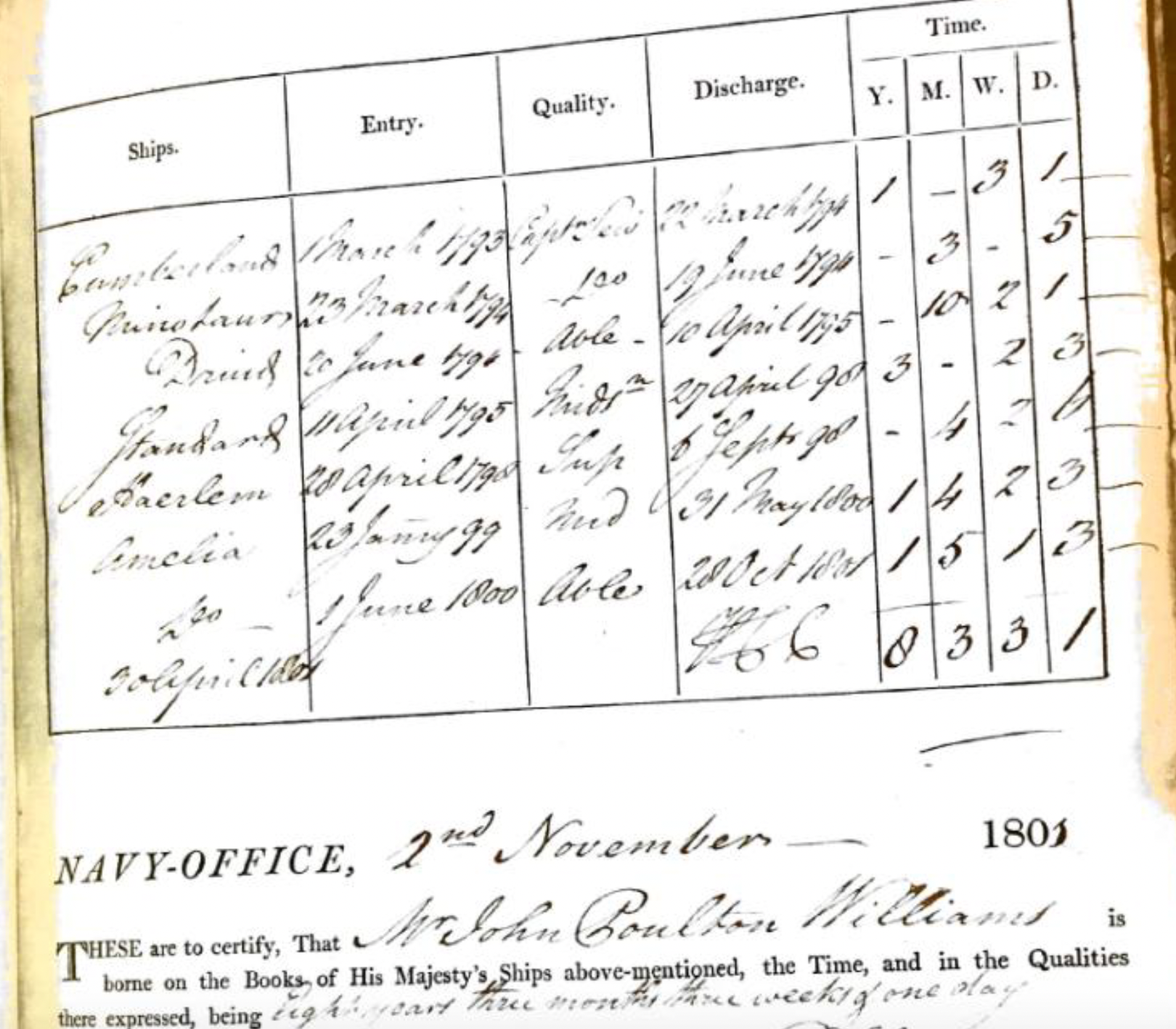
Lieutenants' passing certificates. TNA ADM 107/26. Located using B Pappalardo, "Royal Navy Lieutenants' passing certificates, 1691-1902"
A Boy at Sea
John first entered the Navy in March 1793.
He was just eight years old.
His appointment as a Captain's Servant aboard HMS Cumberland was not domestic service, but the recognised route by which boys connected with naval families began training for commissioned rank. His father's standing within Plymouth Dockyard undoubtedly helped secure this opportunity.
Over the next decade his service illustrates the structured progression expected of a future officer.
He moved first to HMS Minotaur, then HMS Druid, where he was already rated an Able Seaman by the age of ten. Promotion followed to Midshipman aboard HMS Standard, where he served for three formative years.
This period exposed him to events far beyond routine seamanship. During the Nore Mutiny of 1797, one of the most serious challenges ever faced by the Royal Navy, HMS Standard was among the ships whose crews mutinied over pay and conditions. Although only a young midshipman, John witnessed first-hand the tensions that existed even within Britain's victorious navy.
Following a short appointment aboard the captured Dutch vessel Haerlem, he joined HMS Amelia.
It is here that the records present an intriguing puzzle.
After serving as a Midshipman, John was unexpectedly reduced to Able Seaman in June 1800. No explanation survives within the Passing Certificate itself. Was it disciplinary? A consequence of shipboard politics? A reduction in establishment? The answer almost certainly lies hidden within Amelia's surviving log books, reminding us that even where an apparently complete career survives, unanswered questions often remain.
Such mysteries are part of historical research, and sometimes they point towards the next archive visit rather than an immediate conclusion.
Becoming a Lieutenant
John successfully passed his Lieutenant's examination in April 1802, aged just eighteen.
At that point his career enters a different category of records.
Published works such as Steel's Navy Lists begin recording his commission and seniority year by year, allowing his progress through the commissioned ranks to be followed with confidence. These publications were effectively the Royal Navy's annual directory, recording officers, ships and promotions long before the official Navy List appeared in 1814.
Yet the published lists tell only part of the story.
To discover where an officer actually served requires another class of Admiralty records.
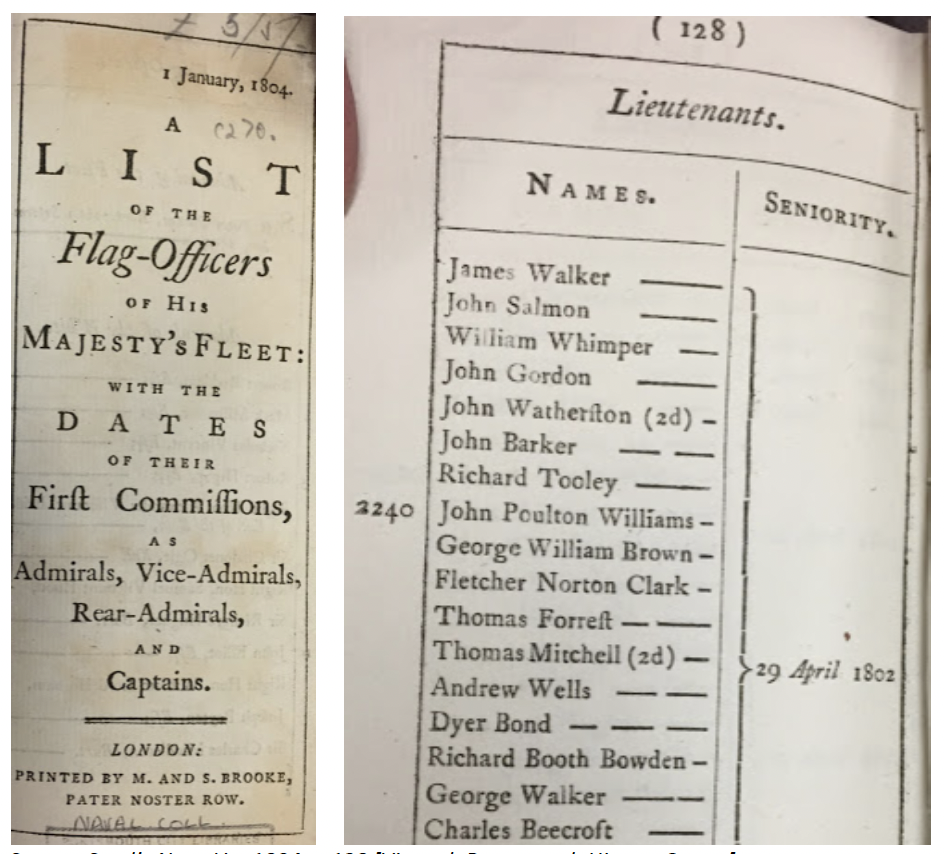
Steel’s Navy List, 1804. p. 128
Muster Rolls and HMS Euryalus
Muster Rolls are among the richest surviving sources for naval research.
Compiled regularly throughout a ship's commission, they record every officer and seaman aboard, when they joined, where they came from and, ultimately, when they left.
John's Muster Roll entry confirms that he joined HMS Euryalus on 20 January 1803.
He would never serve aboard another ship.
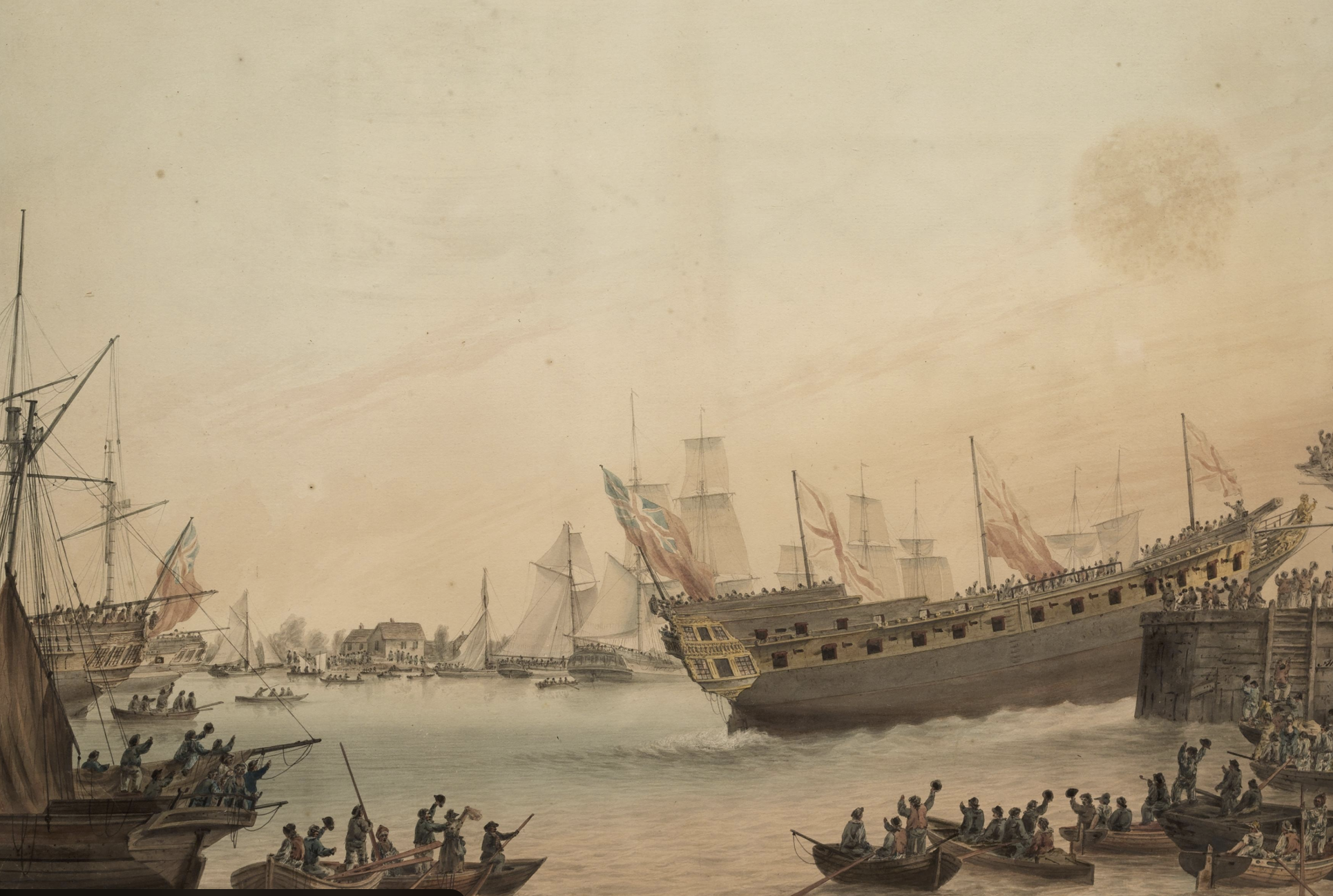
Samuel Atkins, The Launch of H.M.S. Euryalus, Bucklers Hard, 1803
Beyond Trafalgar
HMS Euryalus occupies a distinguished place in the history of the Napoleonic Wars.
Commanded by Captain the Honourable Henry Blackwood, she became one of Nelson's principal frigates during the blockade of Cádiz. It was Euryalus that maintained the close watch upon the combined Franco-Spanish fleet in the crucial days before Trafalgar, earning the sobriquet "Nelson's Watchdog."
On the morning of 21 October 1805, it was from Euryalus that the first signs of movement by the enemy fleet were confirmed. Throughout the battle she fulfilled the vital reconnaissance and signalling duties expected of a frigate, remaining close enough to observe every movement while avoiding becoming engaged in the line itself.
After Nelson received his fatal wound aboard HMS Victory, Admiral Collingwood transferred his command to Euryalus, from where he directed the remainder of the battle and its aftermath.
John Poulton Williams was one of the lieutenants serving aboard her throughout these events.
Although he left no personal diary or letters, the surviving operational records allow us to place him precisely within one of the defining moments of British naval history.
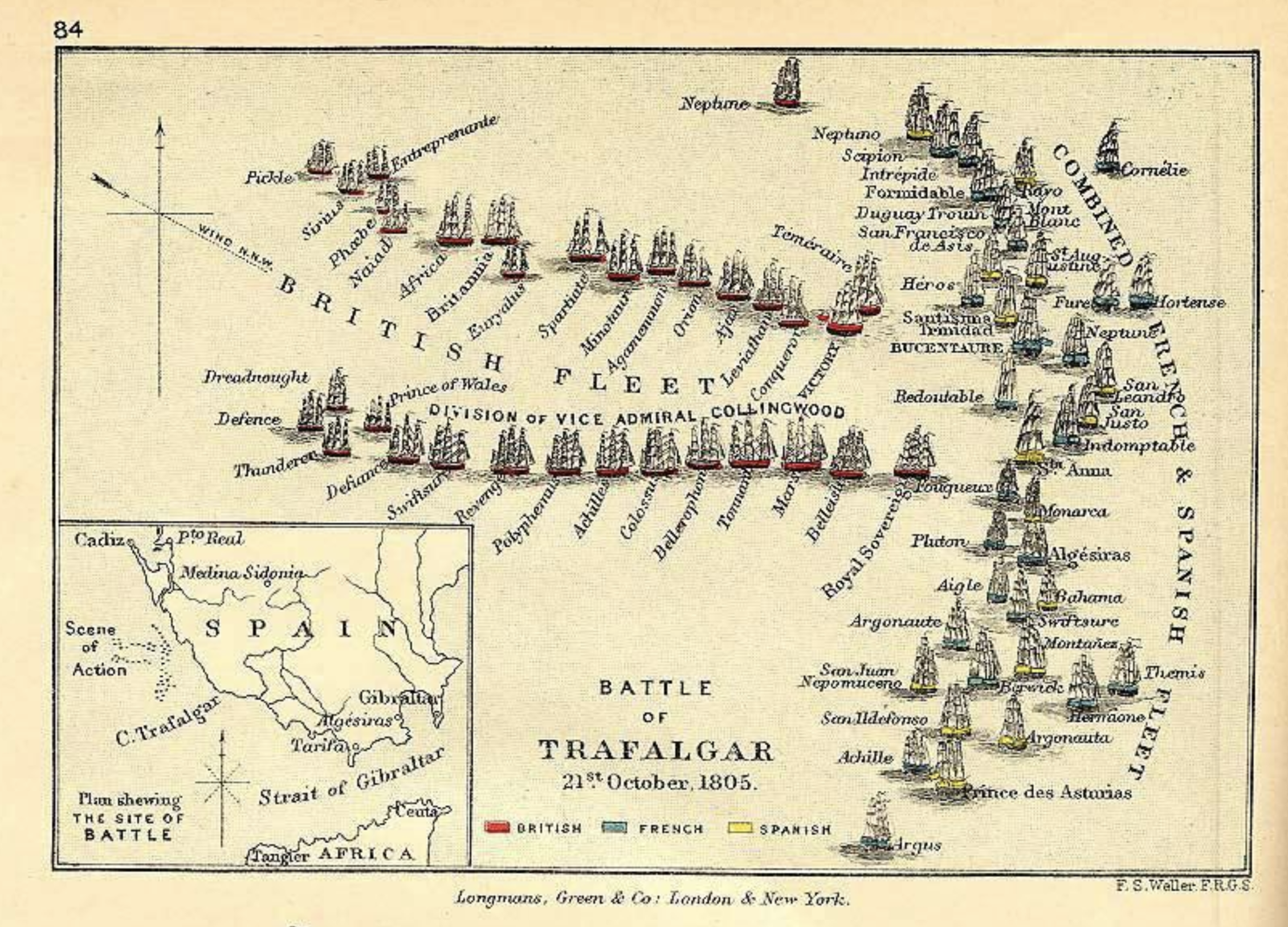
Battle of Trafalgar 21 Oct 1805
Correcting the Historical Record
One of the most satisfying aspects of this research came from resolving a long-standing error.
Colonel Robert Mackenzie's celebrated The Trafalgar Roll states that John was killed in 1809 during an operation off Toulon.
At first glance there seemed little reason to doubt the account.
Yet other records suggested otherwise.
Among the Freemasons' membership registers I discovered that John had been initiated into a Portsmouth lodge in April 1810, together with two fellow officers from HMS Euryalus. Clearly, he could not have died the previous year. His will, proved in the Prerogative Court of Canterbury in July 1812, confirmed only that he had been dead "for several years", narrowing but not resolving the question.
The answer finally emerged from an entirely different source.
A contemporary newspaper report in the Gloucester Journal described an action off Toulon during July 1810. Captain Blackwood's inshore squadron attempted to prevent French warships protecting a convoy entering the harbour. During the engagement HMS Euryalus came under heavy fire.
The newspaper reported:
"...it was attended by the loss of Lieut. Williams and seven men killed, and thirteen men wounded."
The mystery was solved.
Mackenzie's account was essentially correct, but the year was wrong. John had not died in 1809. He was killed in action during July 1810, almost certainly only months after becoming First Lieutenant of Euryalus; a position that normally represented the final stepping stone towards command of one's own ship. His career had every prospect of continuing upward had fate not intervened.
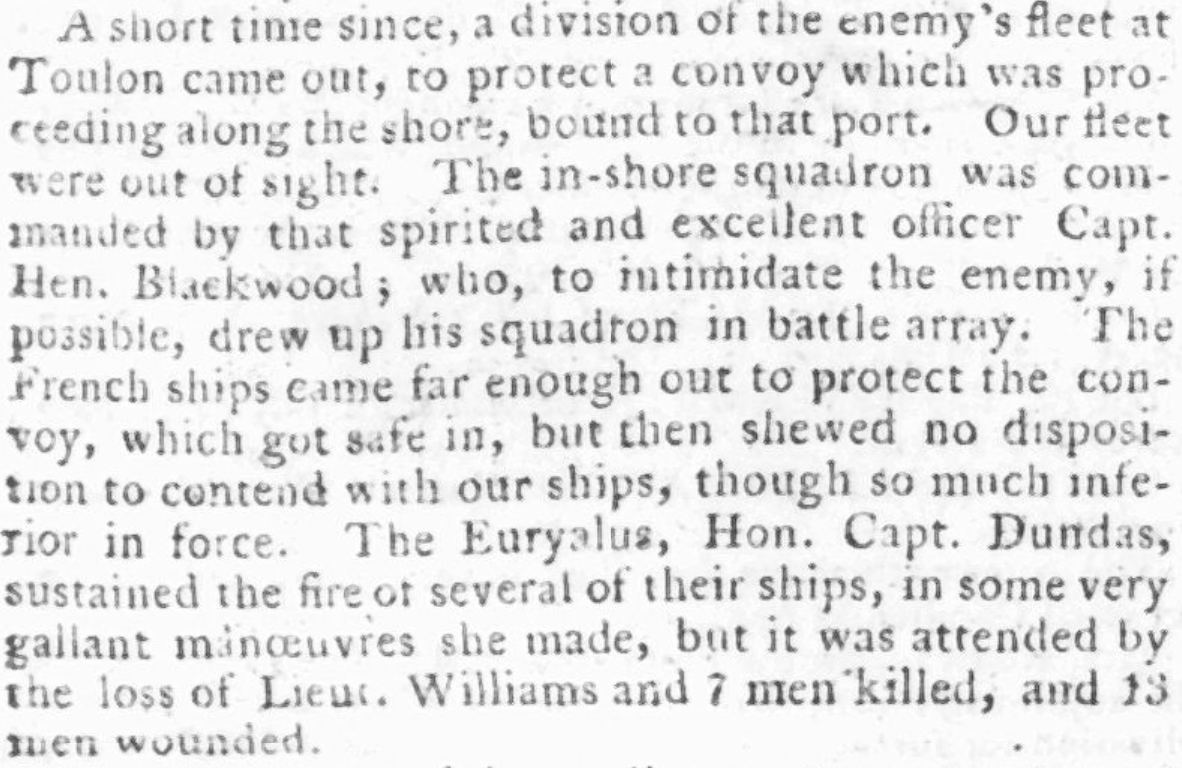
The Gloucester Journal. 1 Oct 1810
A Family at War
John's death was only one chapter in a family profoundly shaped by Britain's wars against France.
His younger brothers Thomas and Poulton both followed him into the Royal Navy. Thomas later lost an arm while serving during the War of 1812 before becoming Superintendent of Police at Devonport Dockyard. Poulton was wounded during the bombardment of Algiers in 1816 before retiring on half-pay.
Military service extended beyond the Navy. Their sister Mary married Lieutenant Henry Strachan of the 73rd Regiment, who was killed during the retreat from Quatre Bras on the eve of Waterloo. Another sister, Ann Maria, married Army surgeon Alexander MacLean, only to be widowed within months when he died shortly after their marriage.
Few families illustrate more vividly the personal cost of Britain's generation-long struggle against Revolutionary and Napoleonic France.
More Than a Name in the Navy List
Without the surviving Admiralty records, John Poulton Williams would be little more than a name in a list of Trafalgar officers.
Instead, a remarkable range of sources allows his life to be reconstructed in surprising detail. Parish registers establish his family and upbringing in Plymouth Dock. His Lieutenant's Passing Certificate charts every step of his early career. Muster Rolls place him aboard individual ships. Steel's Navy Lists record his commission. Probate records reveal his final wishes. Contemporary newspapers identify the circumstances of his death and even correct an error repeated in later published histories.
It is precisely this process of combining evidence from multiple sources that lies at the heart of professional genealogical and historical research. No single record tells the whole story, but when they are brought together they can transform an apparently ordinary naval officer into a vividly documented individual whose life reflects one of the most important periods in British maritime history.
For me, that is one of the greatest rewards of archival research: not simply identifying an ancestor, but recovering the life that lay behind the name.