
Beyond the Medal Card: Tracing Captain Harold James Bristol Through the First World War
How a family story, a single photograph, and a remarkable collection of military records combined to reconstruct the life of a young officer lost in the Great War.
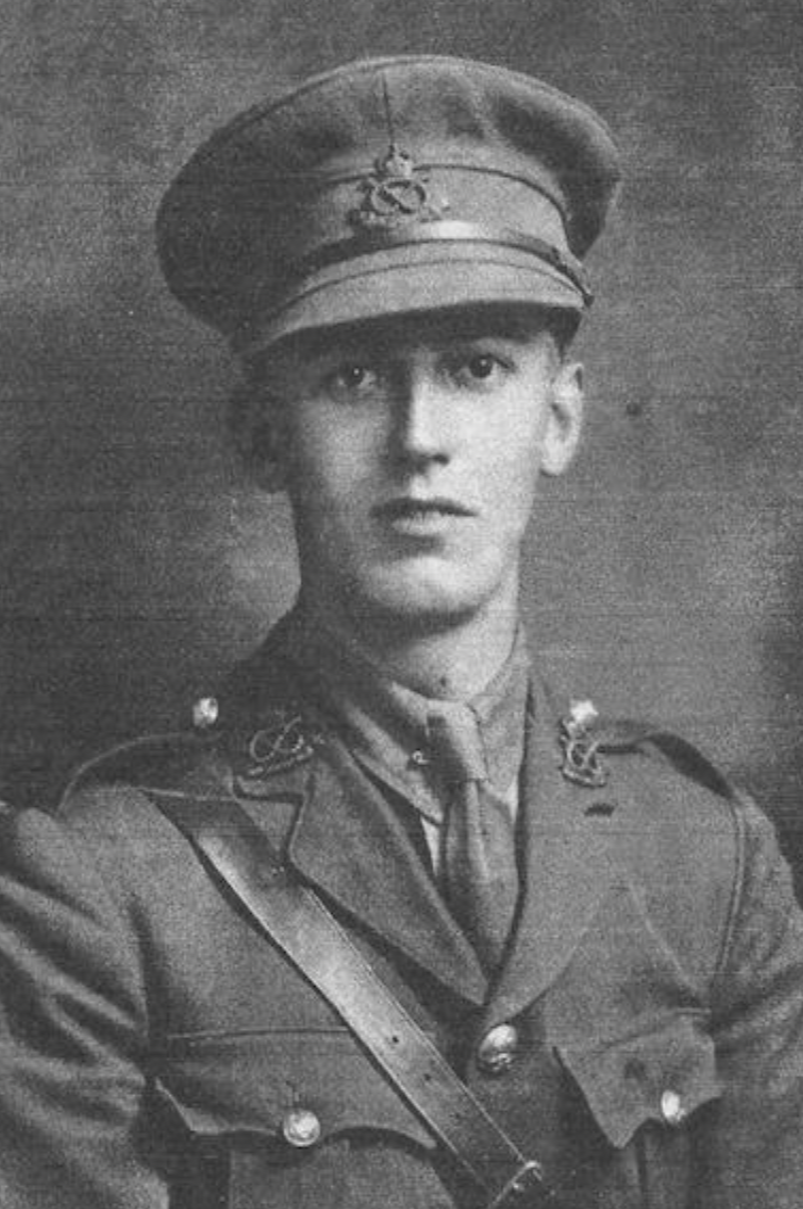
Among my grandparents' possessions was a photograph of a young soldier in uniform. His cap badge was just visible, his expression calm and confident, looking beyond the camera towards a future that, tragically, would never come. He was my great uncle, Captain Harold James Bristol, who died during the First World War at the age of just twenty-one.
Like many families, ours preserved only fragments of his story. Harold had volunteered almost immediately after war was declared in August 1914. He had suffered catastrophic wounds and, according to family tradition, survived for nearly twenty-four hours before finally dying. Beyond that, little was known.
As genealogists, we often inherit these fragments of family memory. They provide a starting point, but not always the whole story. I wanted to discover who Harold really was and what had happened during the four years between leaving home and his burial in northern France.
What followed became one of the most rewarding military research projects I have undertaken.
Beginning with a Name
Knowing Harold had died during the war provided the obvious starting point: the Commonwealth War Graves Commission database.
Within moments his official record appeared.
Harold was buried at Arneke British Cemetery in northern France. He had served with the 4th Battalion, South Staffordshire Regiment, attached at the time of his death to the 10th Battalion, Cheshire Regiment. He died of wounds on 4 May 1918, aged twenty-one, and the record named his widowed mother, Edith Kate Bristol, living in Kensington.
Immediately, the research raised a question.
Why was a South Staffordshire officer serving with the Cheshire Regiment?
Like many good genealogical investigations, one answer quickly led to another question.
More Than a Medal Card
The next stage was Harold's First World War Medal Index Card.
These deceptively simple cards often provide an excellent summary of a soldier's service. Harold's took a little finding. His middle initial had been crossed through by a clerk over a century ago, causing him to be incorrectly indexed. Once located, however, it outlined the broad shape of his military career.
He had first enlisted as a private in the 13th (Kensington) Battalion of the London Regiment, landing in France on 3 November 1914, barely three months after Britain entered the war. Later, on 21 July 1915, he received a commission into the South Staffordshire Regiment, eventually rising to the acting rank of Captain.
The Army Lists allowed that career to be followed almost month by month. They charted his promotion from Second Lieutenant to Lieutenant and eventually Acting Captain, while also revealing something unexpected: during 1916 he disappeared from the South Staffordshire Regiment altogether, transferred instead to the newly created Training Reserve.
Far from indicating a disciplinary issue or unusual posting, this reflected the enormous administrative changes forced upon the British Army after the introduction of conscription. The traditional regimental training system had simply become overwhelmed by the scale of the war. Harold's changing regimental affiliations suddenly made perfect sense.
But the real surprise was waiting at The National Archives.
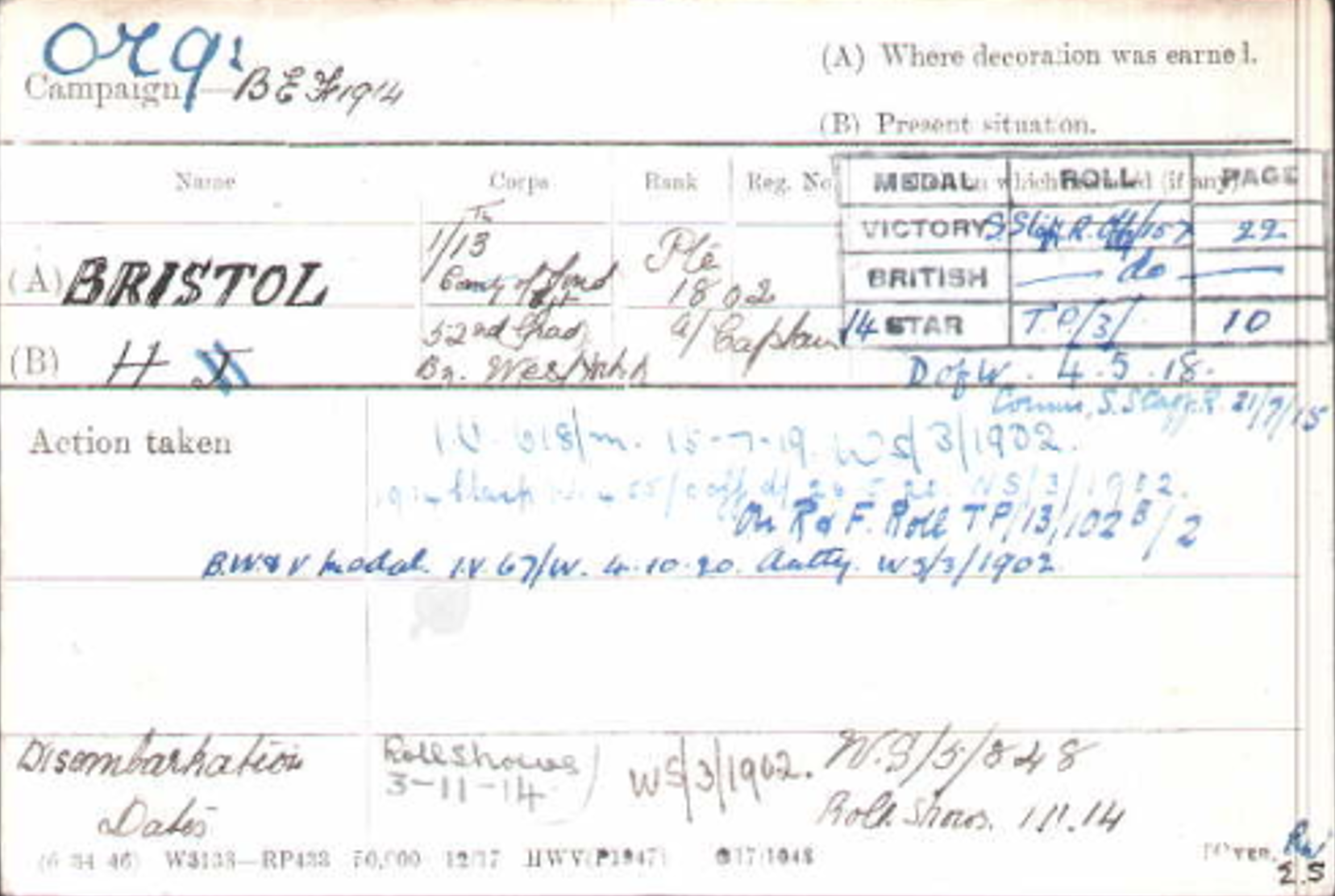
Army Medal Office. WWI Medal Index Cards. In the care of The Western Front Association website.
The Story Nobody Remembered
Harold's officer's service file survives in WO339, one of the principal series for First World War officers' records.
Like many such files, much of it consists of routine correspondence. Hidden amongst that bureaucracy, however, was a remarkably detailed account of Harold's wartime experience.
His attestation papers showed he had enlisted on 6 August 1914—just two days after Britain declared war. He was only seventeen years and six months old.
His medical records then revealed a chapter of his life that had disappeared entirely from family memory.
Harold served on the Western Front for only seven weeks before being invalided home suffering from severe trench foot. He was admitted to a Field Hospital during December 1914 and evacuated to England on Christmas Eve.
What followed was not a quick recovery but nearly eighteen months of medical examinations.
Successive Medical Boards paint an extraordinarily vivid picture of a young officer desperately trying to regain his fitness. One reported that he could barely walk without pain. Another noted that he was unable even to hop on his toes because of the tenderness in both feet. Gradually the reports became more encouraging. He progressed from walking two miles, to four miles, before finally being declared fit for General Service in April 1917.
These clinical documents transformed Harold from a name into a person.
The family had remembered how he died.
The records revealed how he lived.
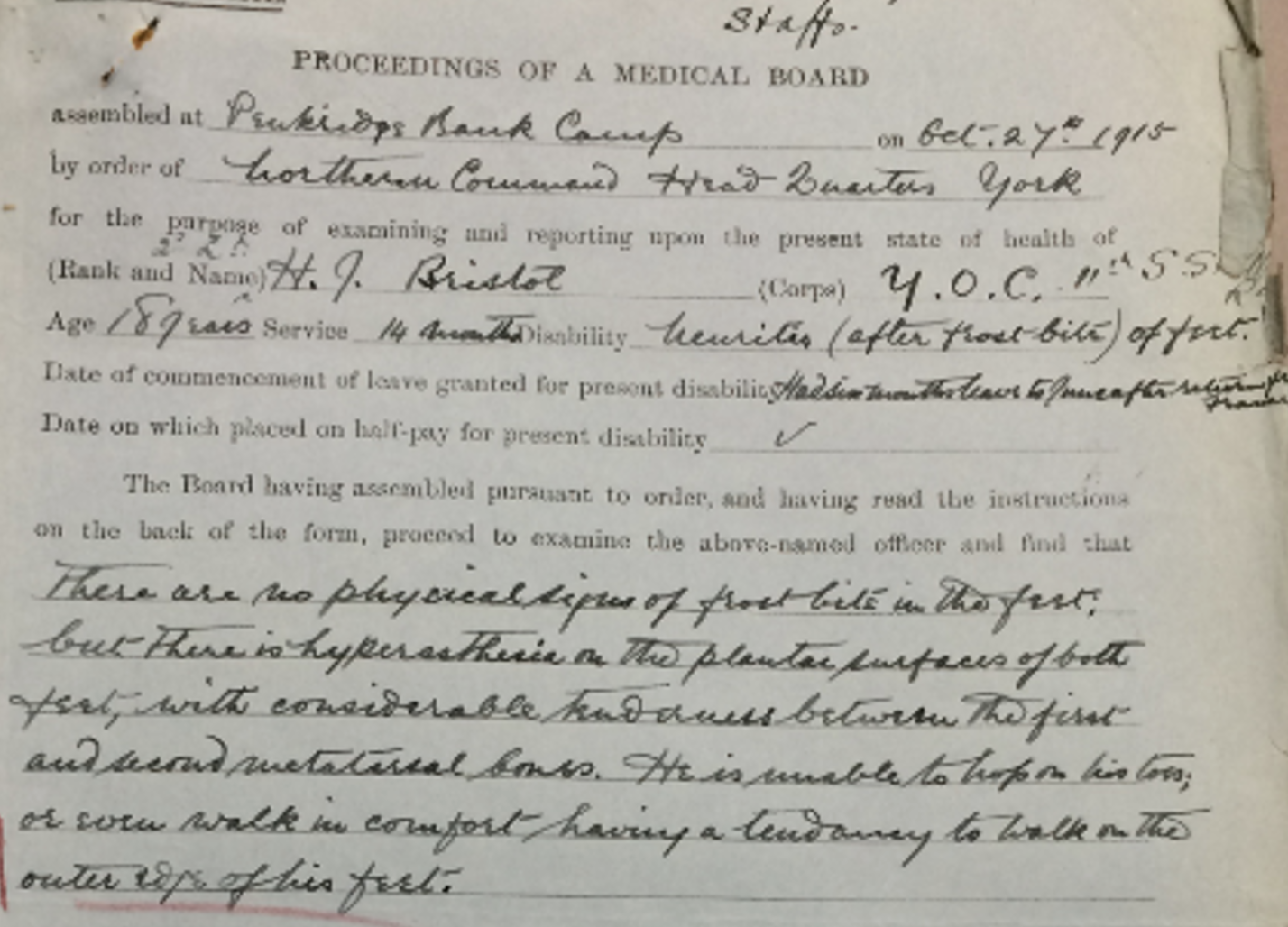
Proceedings of the Medical Board 27 Oct 1915. War Office: Officers' Services, First World War. TNA WO339/35305.
A Young Officer Returns
During Harold's lengthy convalescence he was commissioned into the South Staffordshire Regiment.
It is easy to imagine promotion as recognition of exceptional ability, but the reality of the First World War was often far harsher. Casualty rates amongst junior officers were immense. Young men were promoted quickly because replacements were desperately needed.
By July 1917 Harold had reached the acting rank of Captain.
Then, after recovering from the injuries that had kept him away from the Front for almost two years, he returned to active service.
His correspondence file records his transfer overseas in early 1918.
Within four months he was dead.
Reconstructing Harold's Final Days
The official papers describing Harold's death are brief.
A Field Service Report recorded simply that he died of wounds on 4 May 1918 at the 44th Casualty Clearing Station. A telegram informed his mother of his death two days later. An inventory listed the possessions returned home: his pipe, rosary, wristwatch, cheque book, cigarette case and a letter addressed to a fellow officer.
None of these documents explained where Harold had been wounded.
For that, the investigation moved beyond personal records and into operational history.
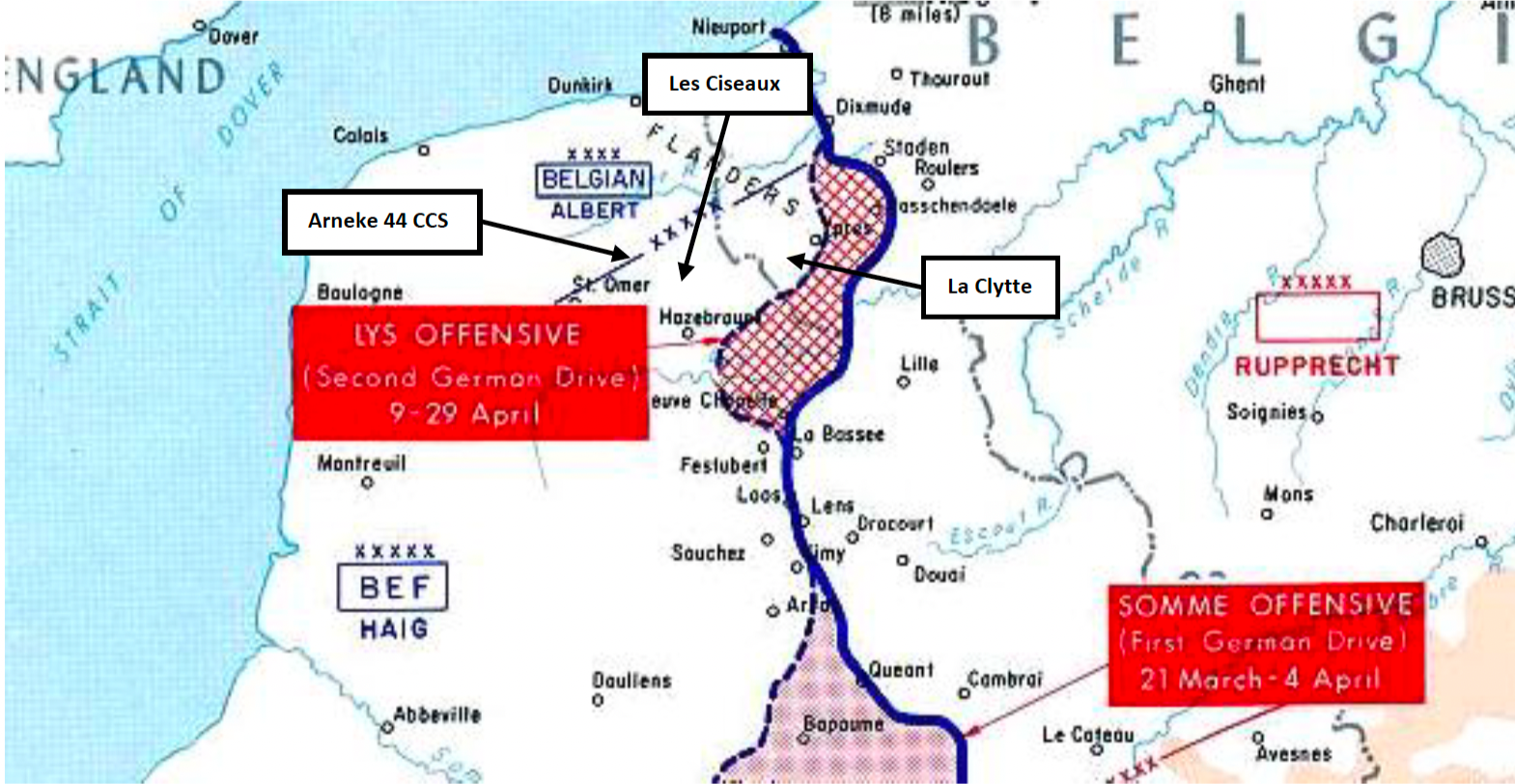
The Commonwealth War Graves Commission had already noted Harold's attachment to the 10th Battalion, Cheshire Regiment. Their war diary records the battalion's movements during the closing stages of the German Spring Offensive.
By combining the battalion diary with the history of the 25th Division and the records of the 44th Casualty Clearing Station, Harold's final journey could be reconstructed.
On 1 May 1918, the Cheshire Battalion occupied positions at La Clytte, south-west of Ypres. Two days later they withdrew westwards towards Les Ciseaux, suffering heavy casualties during the fighting. Harold was almost certainly wounded during this withdrawal on 3 May before being evacuated approximately ten miles to the newly established Casualty Clearing Station at Arneke.
There, on 4 May 1918, he died of his wounds.
No surviving document records the nature of those wounds. The family story describing catastrophic injuries cannot be proved.
What the records do demonstrate, however, is that Harold was wounded on 3 May and died the following day; remarkably consistent with the family tradition that he survived for approximately twenty-four hours.
Sometimes oral history proves more reliable than we expect.
Beyond the Official Record
One of the unexpected highlights of the research came not from an official document but from a famous painting.
War artist Eric Kennington, himself a member of Harold's battalion during the winter of 1914, painted The Kensingtons at Laventie, depicting exhausted soldiers struggling through snow and deep mud after days in the trenches.
Kennington later identified each man in the painting by name.
One of them is Private H. Bristol, wearing a distinctive red scarf.
Suddenly Harold was no longer simply represented by formal studio photographs and military paperwork.
Here he was, standing amongst his comrades in the frozen landscape that had already begun to destroy his feet.
It is a remarkable connection between art, military history and family history.
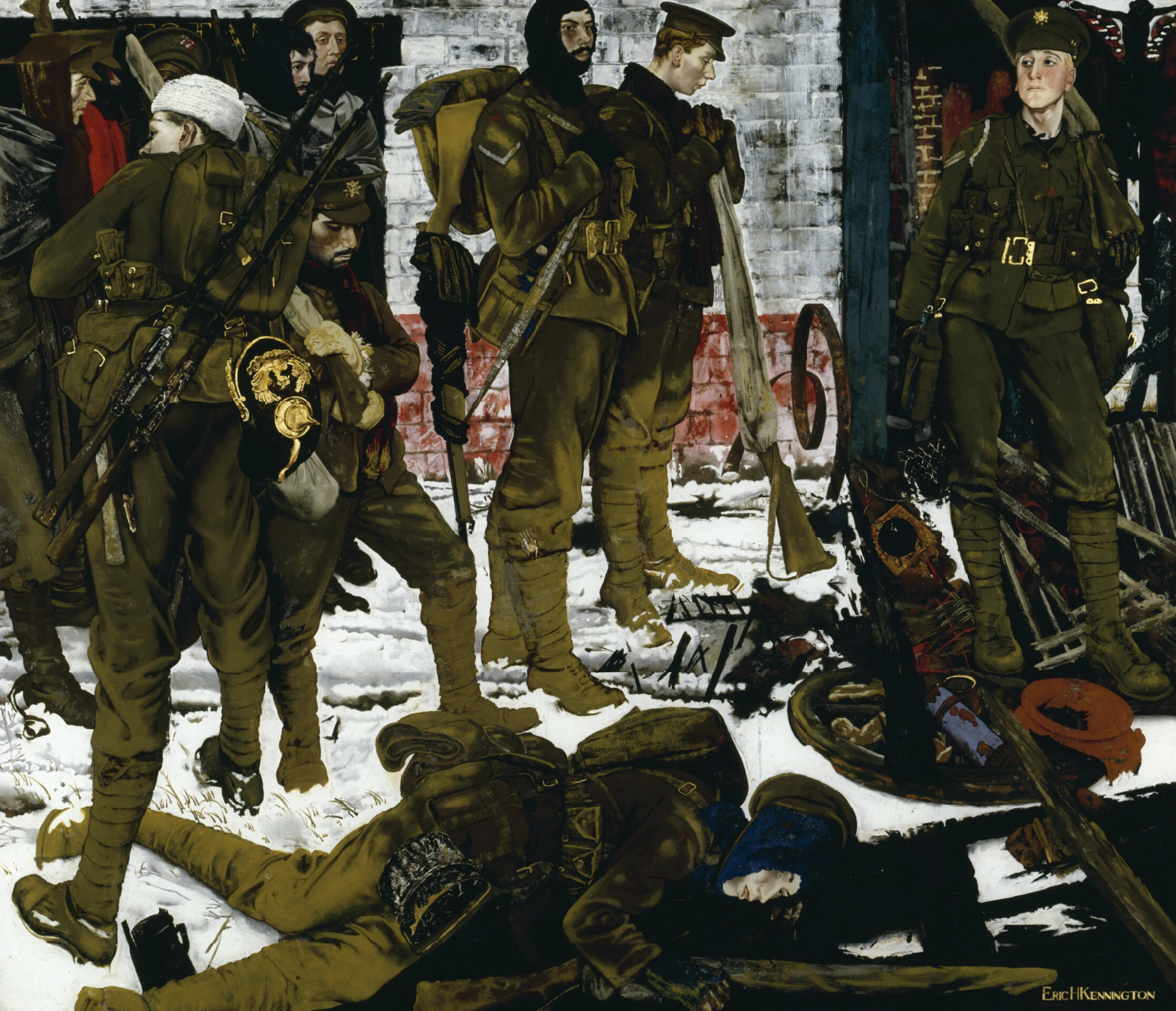
Eric Kennington. The Kensingtons at Laventie
Standing at Arneke
Several years after beginning this research, I visited Harold's grave at Arneke British Cemetery.
It is a peaceful place surrounded by open farmland. Standing there today, it is difficult to imagine that this quiet landscape once lay behind one of the bloodiest battlefields of the First World War.
Yet every record consulted throughout the research, from the Medal Index Card and Army Lists to service records, medical reports, war diaries and casualty record, had led to this single place.
Together they reconstructed a life that had almost disappeared.
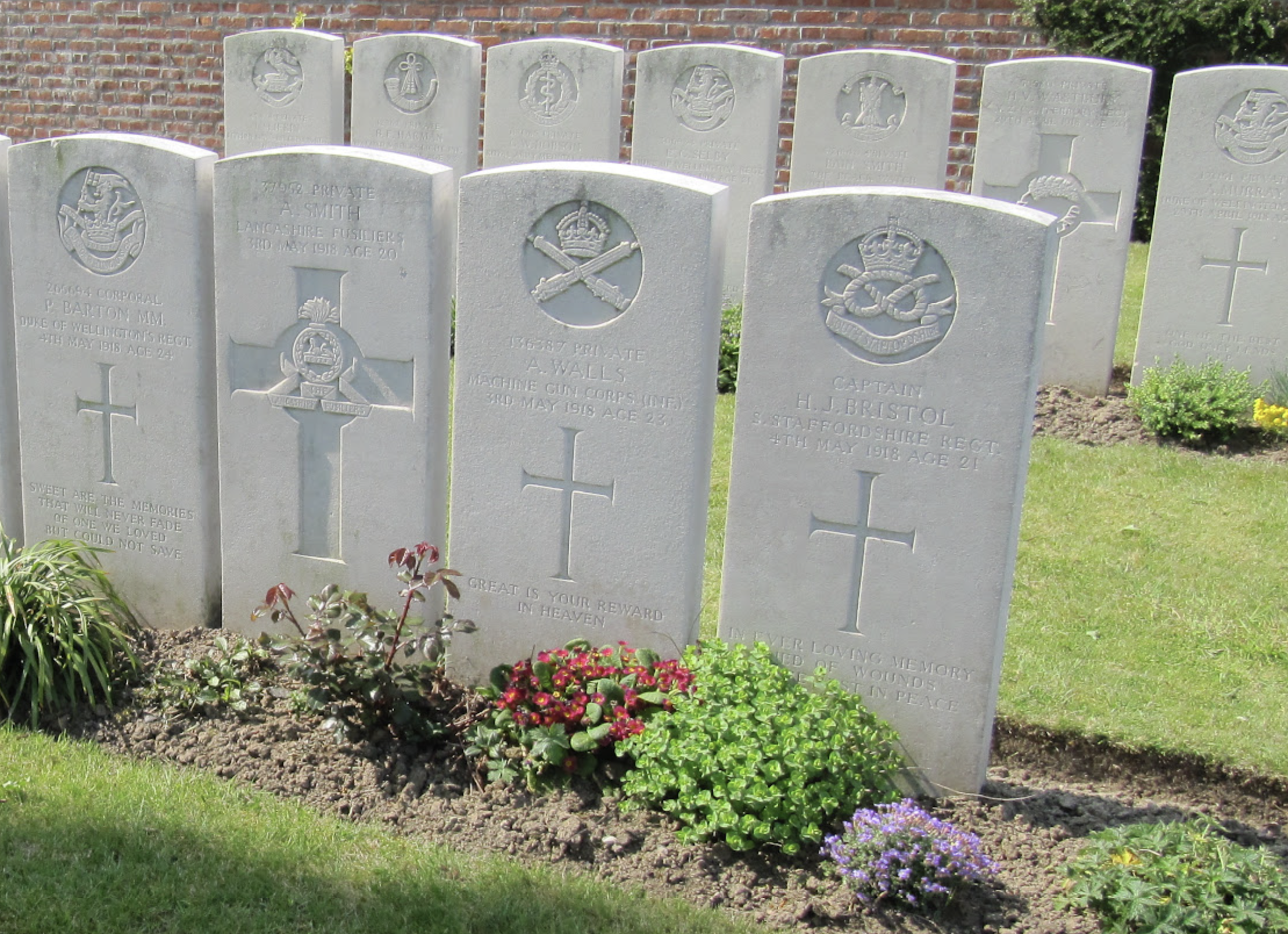
Visit to Arneke Cemetery in Spring 2011
Why This Research Matters
Military research is often seen as the pursuit of medals, battles and regimental histories.
For genealogists, it is something much richer.
It allows us to move beyond names and dates and recover individual lives.
When I began this project, I had little more than a family story and an old photograph. By following the documentary evidence, it became possible to reconstruct Harold's entire wartime experience: his eagerness to volunteer as a teenager, the devastating effects of trench foot, his long recovery, his commission as an officer, his return to France, and finally his death during the German Spring Offensive.
The family had preserved the outline of his story.
The records restored the missing detail.
For me, that is one of the greatest rewards of genealogical research. Every file, every register and every war diary offers the possibility of transforming someone remembered only as a name into a real person once again. Harold was one of the lost generation, but thanks to the remarkable survival of these records, his story can still be told more than a century later.